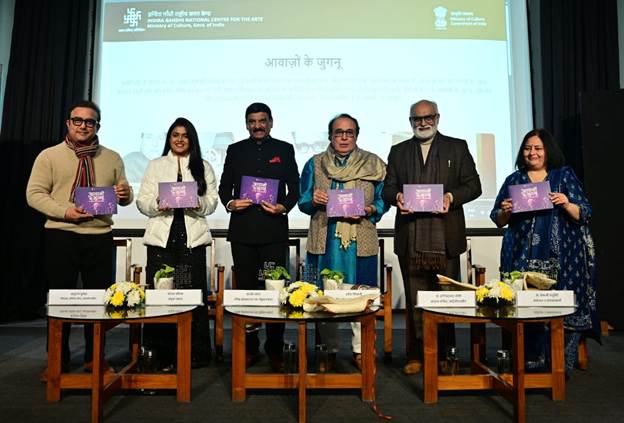
New Delhi: A book launch and discussion programme on “Awaazon Ke Jugnu: The Voice Masters of India” was organised at the Indira Gandhi National Centre for the Arts (IGNCA), Janpath, New Delhi. The event was hosted by the Media Centre of IGNCA and brought together eminent voices from India’s broadcasting and voice-over industry.
The programme was chaired by Sachchidanand Joshi, Member Secretary, IGNCA. Senior broadcaster and legendary voice actor Harish Bhimani attended as the Chief Guest, while Shammi Narang, senior broadcaster, former Doordarshan newsreader and the iconic voice of the Delhi Metro, was the Special Guest. Renowned voice actor Sonal Kaushal, known for voicing popular animated characters such as Doraemon and Chhota Bheem, was the Guest of Honour. The compiler and editor of the book, Dr Shefali Chaturvedi, was also present. The programme was welcomed and anchored by Anurag Punetha, Controller, Media Centre, IGNCA. On the occasion, a QR code was released enabling audiences to access interviews of all the personalities featured in the book.
In his presidential address, Sachchidanand Joshi said that the scope of art is vast and that IGNCA has taken a bold initiative to document a non-traditional yet powerful art form—the world of voices. He announced that an English edition of Awaazon Ke Jugnu would also be released and described the project as the beginning of a larger effort to preserve voice-based artistic traditions.
Addressing the gathering, Harish Bhimani, best known for lending his voice to ‘Samay’ in Mahabharata, said that voice is not merely a tool of communication but a carrier of culture and sensitivity. Quoting a Sanskrit subhashita, he noted that while both the cuckoo and the crow are black, it is their voice that distinguishes them. Describing Awaazon Ke Jugnu as a remarkable initiative, he said the book is not just a collection of words, but an attempt to capture the invisible life force that has shaped collective memory for centuries. He called it “a document of our cultural DNA,” adding that even when words fall silent, the resonance of their crafted sound keeps civilisation alive.
Shammi Narang highlighted the crucial role played by voice artists in Indian broadcasting and stressed the importance of documenting their journeys. Sharing his own story, he spoke about entering the world of voice after studying engineering and emphasised the importance of correct pronunciation and accent. He remarked that speaking well costs nothing, yet leaves a lasting positive impact.

Sonal Kaushal spoke about the opportunities and challenges faced by the younger generation in the voice industry. She shared her professional journey and delighted children in the audience by delivering dialogues of Doraemon and Chhota Bheem, drawing enthusiastic applause.
In his welcome address, Anurag Punetha underlined the power of voice in building trust. He cited a historical example from the Second World War era in the United States, when a radio broadcast about a fictional Martian attack caused panic, demonstrating how deeply people believe what they hear.
Introducing the book, Dr Shefali Chaturvedi explained that Awaazon Ke Jugnu documents the distinctive and memorable voices that have enriched Indian broadcasting through radio, Doordarshan, advertising, dubbing, announcements, and stage poetry. The book details the life journeys, creative struggles, and contributions of these voice artists.
The programme concluded with a vote of thanks by Anurag Punetha, who spoke about taking the Awaazon Ke Jugnu initiative forward. The event was attended by noted radio jockeys and broadcasters including Nitin Khurafati, Simran, Jasleen Bhalla, Saima Rahman, Rajendra Chugh, Rajiv Kumar Shukla, Rini Khanna, Rama Pandey, Shrivardhan Trivedi, and Narendra Joshi. Several speakers also shared their reflections, while scholars, artists, students, and media professionals were present in large numbers, making the programme a meaningful celebration of India’s rich voice culture.